REVIEW · DUBAI
Customizable Private Modern Dubai Tour with Professional Guide
Book on Viator →Operated by ORIENT TOURS LLC SOLE PROPRIETORSHIP · Bookable on Viator
Dubai is a city of giant ideas. This private, half-day route strings together the skyline’s most famous shapes, from the Burj Al Arab sail to the Dubai Fountain Show.
I like how the format gives you personal guide time and photo stops in a short window. You’ll also get a clear sense of how Dubai went from coastal living to space-age construction, with an air-conditioned ride doing the hard work.
One thing to keep in mind: this isn’t a slow, deep architectural lecture. A few stops are mostly quick looks from outside or inside a mall setting, so you should expect highlights more than full technical detail.
In This Review
- Key things to know before you go
- A short, high-impact tour route through modern Dubai
- Pickup, timing, and how to plan around traffic and heat
- Souk Madinat Jumeirah: traditional form, modern scale
- Burj Al Arab from outside: the sail-shaped icon up close
- Palm Jumeirah: the artificial island you can’t ignore
- Ski Dubai at the Mall of the Emirates: Dubai’s favorite contradiction
- Burj Khalifa: the viewpoint lesson you’ll remember
- Dubai Fountain Show: the timing-and-music finale
- What you’re really paying for with $89 per person
- Guide quality makes or breaks the experience
- Who should book this modern Dubai architecture tour
- Should you book this tour?
- FAQ
- FAQ
- How long is the Dubai modern architecture tour?
- What’s included for the tour stops?
- Does the tour include the Dubai Fountain Show?
- Are food and drinks included?
- Is this a private tour?
- Can the itinerary be customized?
- What language options are available for the guide?
Key things to know before you go
- Private guide + hotel pickup: easier, faster start than figuring it out yourself.
- Short photo-stop strategy: you’ll see the big icons without losing half your day to traffic.
- Burj Al Arab, Palm, Ski Dubai: the tour mixes true landmarks with Dubai’s playful contradictions.
- Burj Khalifa + Fountain Show: the ending is timed for a must-see evening performance.
- Guide language can vary: confirm your exact language choice when booking.
- Fountain shows can be paused: management can cancel without notice.
A short, high-impact tour route through modern Dubai
Dubai can feel like a sci-fi brochure in real life, and this kind of half-day tour is built for that effect. You’re not wandering neighborhoods for hours. You’re taking a focused loop meant to show you the city’s new identity in one sitting.
I especially like the ride-and-interpret setup. The air-conditioned vehicle keeps you comfortable while your guide turns the big shapes into understandable stories: what was built, what problem it solved, and why it became a Dubai “signature.” If you’re visiting for the first time, that overview helps you decide what to return for later.
The other strong point is the balance between wow-factor and context. You get iconic stops with the right photo angles, but you also get explanations that connect the dots—Dubai’s growth, the way major developments cluster, and how the skyline became a global brand.
You can also read our reviews of more guided tours in Dubai

Pickup, timing, and how to plan around traffic and heat
You’ll start with pickup from a central Dubai hotel in a private air-conditioned vehicle. Expect a route that includes several photo stops rather than long, ticket-heavy visits. That matters because Dubai driving can eat time. The tour duration can also shift based on traffic, so it’s smart to keep your next appointment flexible.
If you’re going in the summer (June–September), plan like a realist. Daytime temperatures can reach 42–45°C, with humidity that can go over 90%. Light clothing helps, but the bigger win is the air-conditioned transport between stops. Sunglasses and a hat are a good idea because the sun is strong even when you’re only outside briefly.
One practical note: the Dubai Fountain Show is a “might happen, might pause” moment. Fountain management can call off the show without prior notice. It’s rare, but it’s real enough that you should mentally treat the fountain as the bonus ending, not the guaranteed centerpiece.
Souk Madinat Jumeirah: traditional form, modern scale
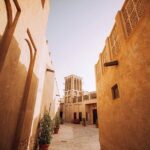
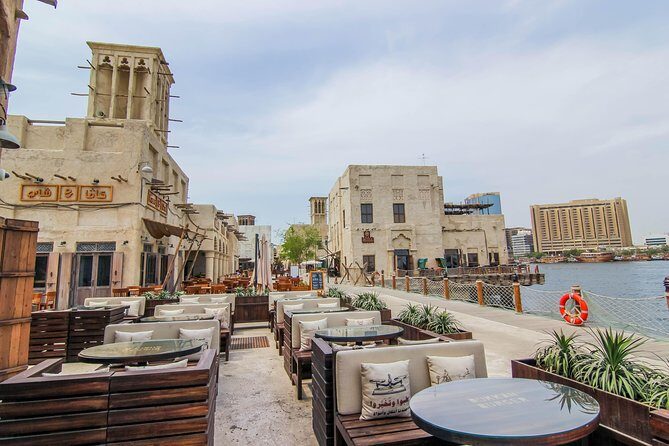
The tour typically begins around Souk Madinat Jumeirah, a recreation of a traditional Arabian marketplace built in the middle of Dubai’s modern development. This stop is less about shopping and more about orientation.
Here’s why it works. Dubai’s architecture isn’t only glass towers. It also uses cultural styling—arches, courtyards, water channels, and “old market” shapes—to make the city feel themed. Seeing Souk Madinat Jumeirah early gives you a reference point: you start to notice how Dubai mixes heritage signals with futuristic execution.
What you can do in this first stretch depends on the guide’s pacing, but you’ll have time to take in the setting and get comfortable with the area. If you like photography, look for the layered views—buildings framed by walkways and water features often photograph better than the obvious street angles.
A fair consideration: this is a “beginning-of-tour stop,” not the kind of place you’ll fully explore during a half-day. If you love markets, you might want a longer separate visit later.
Burj Al Arab from outside: the sail-shaped icon up close
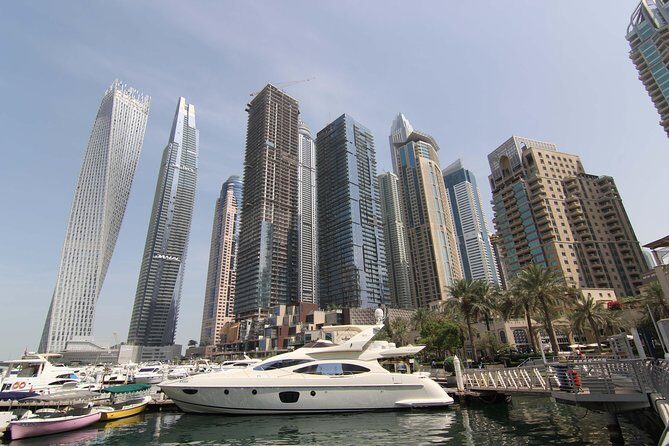
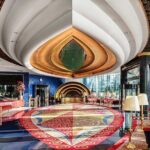
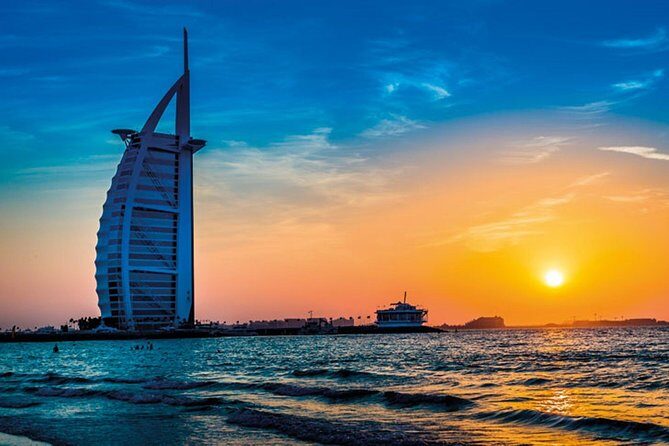
Next comes the Burj Al Arab, the gleaming hotel designed to look like a billowing sail on an artificial island off Jumeirah’s coast. From the road, you’ll see it rise dramatically above the surrounding development, and you’ll get a photo stop from outside.
The height is part of the story: the Burj Al Arab reaches about 321 meters (1,053 feet). That’s not just trivia. It explains why it dominates this stretch of coastline and why it became such an instantly recognizable Dubai symbol.
What I’d focus on is how the building’s “shape language” works. This isn’t a tower that hides its concept. It announces itself. The sail idea turns a hotel into a landmark, which is exactly the kind of branding Dubai does well—turning architecture into a headline you can photograph from multiple angles.
Practical tip: if your timing is tight, don’t waste your entire stop lining up the perfect shot. Take one “wide context” photo (to show location) and one tighter “shape” photo (to show the sail lines). You’ll thank yourself later when sorting your pictures.
Palm Jumeirah: the artificial island you can’t ignore
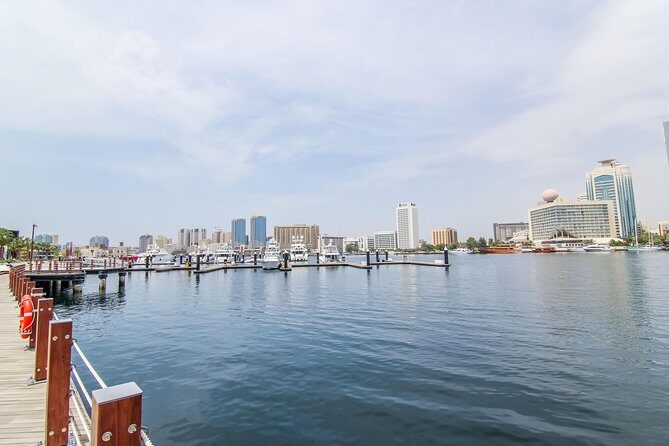
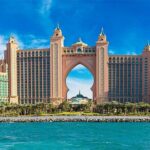
Then you head to Palm Jumeirah, the palm-tree-shaped archipelago built into the Persian Gulf. This stop is pure Dubai logic: create a new landform, then build a luxury skyline around it.
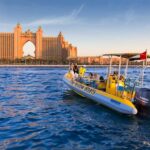
You’ll drive through the area, and the route includes a view of Atlantis The Palm, which acts like the island’s architectural showpiece. In a half-day format, you won’t be wandering the fronds for long. Instead, you’re getting the key impressions fast: the scale, the design layout, and the way the villas and complexes “follow” the palm’s engineered geometry.
Why this matters for your trip:
- It shows you how Dubai’s biggest projects aren’t only vertical. They’re also about reshaping the shoreline.
- It helps you understand the city’s willingness to build at massive scale to create new destinations.
A consideration: if you want time inside Atlantis or to fully explore the Palm promenade, this tour format may feel short. The value here is the viewpoint and orientation, not the full island experience.
You can also read our reviews of more private tours in Dubai


Ski Dubai at the Mall of the Emirates: Dubai’s favorite contradiction
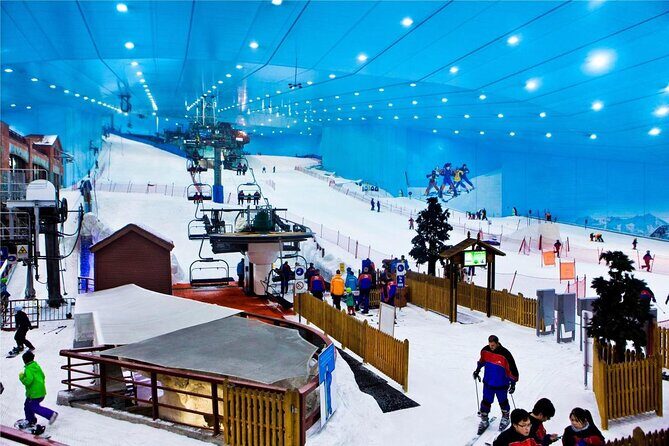
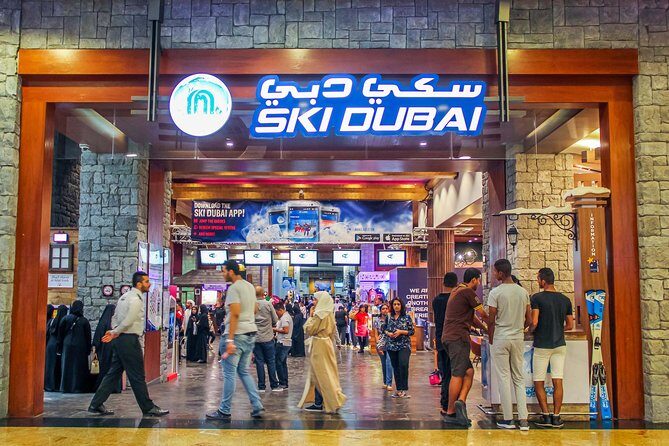
After the Palm, the tour typically moves to Ski Dubai, the first indoor ski resort built in the Middle East. It’s housed in a mall, so it’s not exactly “ski village life.” But that’s part of the charm.
You’ll likely get a photo stop outside, meaning you’ll spend time seeing the giant ski runs through glass and learning how the snow is maintained with snow guns that renew the slopes every night.
What I like about including Ski Dubai in an architecture-themed outing is that it broadens what “futuristic” can mean. Dubai’s innovation isn’t only about height and materials. Sometimes it’s about controlling environments. Indoor skiing in a place known for extreme heat is a loud example of Dubai’s engineering confidence.
If you’re sensitive to crowds in malls, be prepared for a busy feeling during your stop, especially at popular times. This is another reason why the quick photo stop approach can be a good trade-off.
Burj Khalifa: the viewpoint lesson you’ll remember
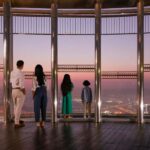
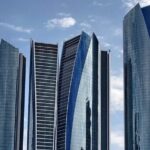
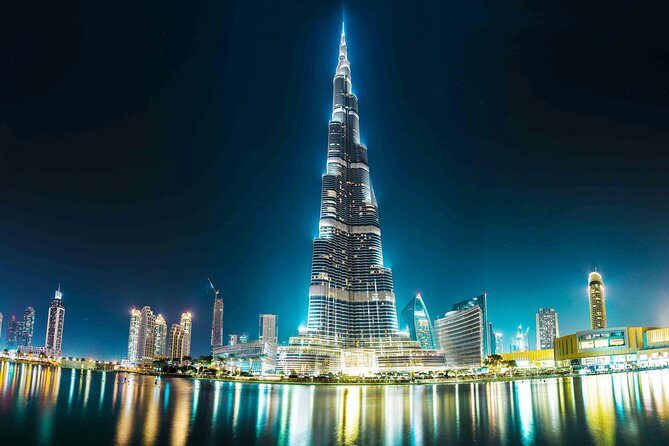
The highlight architecture finally arrives with Burj Khalifa, one of the world’s highest buildings. You’ll approach Burj Khalifa Lake for the ending, but first you’ll have time around the tower area to get the big picture—and yes, the guide will point out the needle-like top that’s hard to see without looking up.
The building height is about 828 meters (2,772 feet). That scale changes your perception. From ground level, the tower doesn’t feel like a “building” so much as a vertical instruction: everything in the skyline is now in orbit around this needle.
If you’ve only ever seen Burj Khalifa from distant postcards, seeing it at close range changes the math. The tower’s mass, the surrounding plaza design, and the way the city’s modern road network supports the monument all start to make sense.
Dubai Fountain Show: the timing-and-music finale
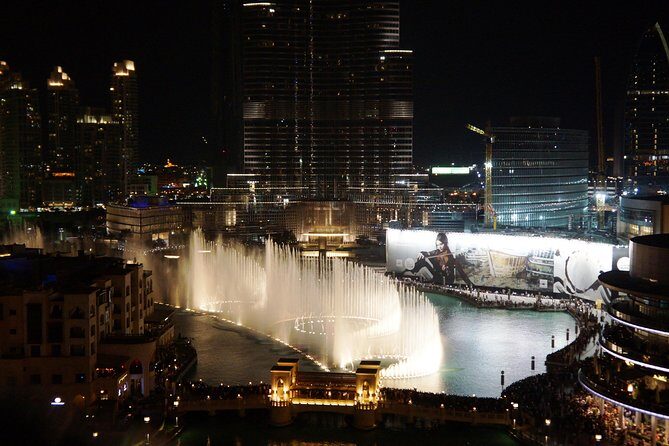
To wrap up, you’ll watch the Dubai Fountain Show at Burj Khalifa Lake. This is where Dubai’s architecture and entertainment shake hands.
The show is about five minutes long, and it’s choreographed with Arabic and classical music. The fountain system includes jets and 6,600 lights and lasers, producing water sprays that rise and fall with tight precision. It’s the kind of spectacle you don’t need to “get” intellectually first. You just feel it when it starts.
Here’s how to make the best of your seat time:
- Go in with a willingness to watch the timing, not only the biggest bursts.
- If you’re taking photos, switch between wide shots (show the water pattern) and close shots only if the fountain rhythm allows it.
- After the show, don’t plan to linger too long—your return ride ends at your hotel drop-off.
Important reality check: the fountain management can cancel the show without prior notice. If that happens, you still get Burj Khalifa area time, but the “dance” moment may not occur. Build your expectations accordingly.
What you’re really paying for with $89 per person
At $89 per person for about four hours, this tour can be good value if your goal is orientation plus skyline highlights, not deep building access.
You’re paying for:
- Private transportation in an air-conditioned vehicle
- Hotel pickup and drop-off, which saves time in a city where the “last mile” can be annoying
- A professional guide who connects the dots across multiple iconic stops
- Photo-stop time at major landmarks like Burj Al Arab, Ski Dubai, and Burj Khalifa
The attractions are listed as included for inside visits based on the option you select, but the stops themselves are largely designed around quick visual access. That’s why the price can work: you’re not stuck buying lots of separate tickets for a dozen add-ons during one short window.
Where the price can feel less worth it is if you expected a slow, technical architecture deep dive. Some people have found the tour more like a sightseeing loop with architecture-adjacent commentary than a full “how it was built” masterclass.
To maximize the value, do this:
- Tell your guide what you’re most curious about: skyline planning, building design choices, or Dubai’s growth from fishing village to space-age city.
- Ask for one or two specific “compare and contrast” explanations as you move between stops.
Guide quality makes or breaks the experience
This tour is private, so the guide’s delivery matters a lot. The strongest feedback you’ll see for this kind of Dubai loop is about guides who are friendly, attentive, and ready to adapt to small-group needs.
In past notes, guide names like Dejan and Ahmed Khalifa show up with praise for being accommodating and helpful. Even when the schedule is tight, a good guide keeps things moving without turning it into a rush.
Language is another detail to check. The operator lists multiple languages (including English and German, plus others), but one issue in feedback shows that Spanish requests didn’t always match the expectation. If language matters for you, confirm your exact guide-language option before you go.
Also, don’t be surprised if the tour uses a fact-sheet style for certain quick stops. If you want more depth, ask follow-up questions in plain terms. Guides tend to respond best when you steer them toward the kind of architecture story you want.
Who should book this modern Dubai architecture tour
This tour makes the most sense if:
- You’re short on time and want the skyline’s biggest hits in one afternoon or evening loop.
- You like architecture in a broad sense—icon shapes, city planning, and how Dubai markets itself through buildings.
- You want a guide to handle logistics while you focus on photos and landmarks.
It may disappoint you if:
- You’re looking for long time inside each building or a deep technical breakdown of construction methods.
- You hate quick photo stops and prefer slow, museum-style pacing.
- You’re going to the fountain show only for the fountain. Since cancellations can happen, you should be okay with a Plan B mindset.
If your group is small, private time can be a real advantage. One benefit of a private vehicle is that you can often work around minor preferences like where to stand for better photos, as long as the schedule stays on track.
Should you book this tour?
I’d book it if you want a practical first look at modern Dubai—Burj Al Arab, Palm Jumeirah, Ski Dubai, Burj Khalifa, and the fountain finale—without spending your whole day juggling rides and tickets.
I’d reconsider if you specifically want a true architecture seminar with lots of time at each site. The tour’s strength is focus, not length. You’ll come away with better orientation and better photo targets, and you can use that to plan longer follow-up visits later.
FAQ
FAQ
How long is the Dubai modern architecture tour?
It’s approximately 4 hours, and the total time includes pickup and drop-off. Traffic can affect the exact timing.
What’s included for the tour stops?
You’ll have hotel pickup and drop-off in a private air-conditioned vehicle, bottled water, and photo stops from outside for Burj Al Arab, Ski Dubai, and Burj Khalifa. Attraction entry is included depending on the option you select.
Does the tour include the Dubai Fountain Show?
Yes, the itinerary includes the Dubai Fountain Show at Burj Khalifa Lake. The fountain management can cancel the show without prior notice.
Are food and drinks included?
No, food and drinks are not included.
Is this a private tour?
Yes. It’s private, and only your group participates.
Can the itinerary be customized?
You can discuss customization with your guide. If any additional entrance tickets are needed, you’ll pay those directly.
What language options are available for the guide?
The tour information lists multiple speaking guides (including English, German, Spanish, French, and Italian). If you’re booking a specific language like Spanish, confirm the exact language option with the provider when you book.